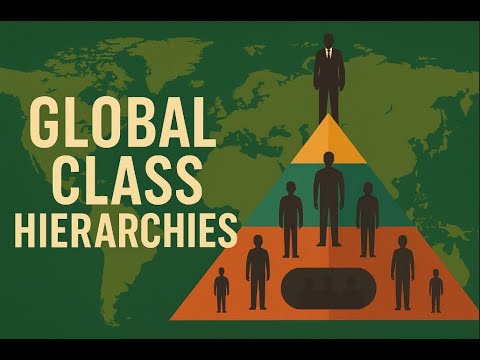

The Flawed Conventional View of Social Hierarchies
The feudal and five-class models wrongly assume societies like modern America follow rigid pyramids. In reality, this analysis overlooks the U.S.’s uniquely competitive elite structure, where status is less monopolistic than in countries like Canada or Australia. This essay redefines class hierarchies across diverse systems—from Europe’s welfare-state model to emerging markets—and explores how AI may reshape them entirely.
The American Class Hierarchy: Two Diverging Paths
The U.S. system isn’t a single pyramid but two paths that diverge above the working class:
-
Underclass: Dependent on welfare, often in rural or urban areas, with limited formal economy participation.
-
Working Class: Earns enough to survive, sometimes with debt, but faces barriers like negative welfare incentives.
-
Middle Class (Clerical): Corporate administrators and truck drivers with disposable income but trapped in 9-to-5 jobs.
-
Establishment Elite: Old money, top officials, and politically connected figures with institutional control.
-
Ivy League Class: High-earning professionals (e.g., lawyers, executives) who work to join the elite but lack generational wealth.
-
Institutional Professional Class: $100–200k/year workers serving elites, like corporate consultants.
-
Independent Professional Class: Entrepreneurs in emerging industries, often excluded from traditional networks.
-
Successful Business Owners: Self-sustaining entrepreneurs matching Ivy League incomes.
-
Counter Elite: Wealthy individuals (e.g., immigrant families) outside the establishment’s social circle, with financial but not institutional power.
Key Differentiator: Not income, but how money is earned and residual wealth—plus alignment with the establishment’s cultural and political order.
The European Class Hierarchy: Stability Through Welfare and Taxes
Contrary to myths of egalitarianism, Europe’s system uses high taxes and social welfare to create a large lower middle class:
-
Underclass: Dependent on state aid, including unassimilated immigrants and those excluded by strict labor laws.
-
Lower Middle Class: Comfortable but financially stagnant, with median savings lower than China’s despite higher incomes.
-
Managerial Class: Higher-income bureaucrats and executives, with upward mobility tied to political office.
-
Old Money: Families like London’s landowners or the Heineken dynasty, protected by progressive taxes that limit competition.
This structure, rooted in post-war welfare expansion, pacifies the population while preserving old elites’ power. Paradoxically, Europe’s focus on social stability disincentivizes savings and entrepreneurship.
Authoritarian Regimes: Power Through Control and Connection
Authoritarian systems like China’s and Russia’s feature a dual pyramid with key differences:
-
Underclass: Survives outside the formal economy via subsistence farming or black markets.
-
Working Class: Lower-income than U.S. counterparts, with limited upward mobility.
-
Party-Connected Professional Class: Bureaucrats and entrepreneurs tied to the ruling party.
-
Well-Connected Wealthy: Friends and family of party leaders, often veterans, who gain permits and contracts.
-
Party Leadership: The regime’s top decision-makers, who suppress independent challengers (e.g., China’s tech crackdown).
Unlike the U.S., old money is absent—elites from previous regimes are killed or exiled. Power relies on force, with military influence concentrated among the well-connected.
Emerging Markets: Stratified Pyramids and Old Money Dominance
Emerging markets like Latin America and South Korea share traits:
-
Underclass: Illiterate, informal economy workers easily manipulated by old money-backed parties.
-
Middle Class: Lower-middle (factory workers) and educated (professionals), both unable to break into the elite.
-
Old Money: Generational families controlling businesses and politics, resisting reforms that threaten their power.
South Korea stands out with a smaller underclass and vibrant consumer economy, though tensions persist between chaebol (conglomerates) and the middle class.
The Pre-Modern Era and the Rise of Class Warfare
Before the French Revolution, class structures were simple:
-
Old Money Ruling Class: Conquered power through force.
-
Enforcer Class: Knights or military maintaining control.
-
Slave/Peasant Class: Underpaid laborers sustaining the economy.
-
Free Citizens: Skilled artisans and clergy with limited autonomy.
Revolutions and literacy empowered lower classes, leading to two outcomes:
1. Class Warfare: Elites split, aligning with middle or working classes to distract from hierarchy.
2. Authoritarian or European Models: Welfare states or force-based control.
AI and the Future of Class Hierarchies
Recent AI breakthroughs—like ChatGPT and Google’s Mobile Aloha—threaten to dismantle traditional social contracts:
-
First Generation (20 Years):
-
Dependent Class: Workers displaced by AI, sustained through machine taxes or elite-funded welfare.
-
Old Money & Politicians: Maintain control over automated production.
-
Robots & AI: Perform physical and white-collar tasks.
-
End Generation:
-
Dependent class declines as AI replaces most jobs. Rogues form independent communities, but lack scale to challenge elites.
This scenario mirrors pre-modern hierarchies without enforcers, as robots operate via hard-coded instructions. While this process may take 200 years, it poses existential questions: Will AI empower elites to eliminate lower classes, or will counter-elites find ways to reclaim control? The future hinges on technological pace and innovations like space travel that could redefine human roles.
This is a theory, not fact. Social pyramids evolve rapidly, especially in authoritarian regimes and emerging markets. Share your thoughts—does AI signal the end of class warfare, or a new battlefront?
 {#
{#